It is early
morning and a team of science journalists are heading to Western Uganda on a
fact finding visit about banana rich in
Vitamin A and iron bred using transgenic technology by a team of Agricultural scientists at the National
Agricultural Research Laboratories(NaRL).
Upon
arrival at Mbarara Zonal Agricultural Research and Development Institute
MbaZARD) there is field
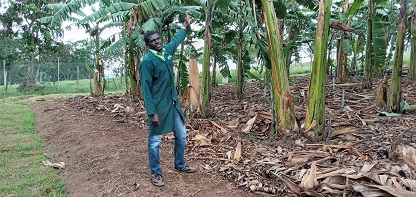
trial site that with banana performing well.
The same
applies to the trial site at Bulindi Zonal Agricultural Research and
Development Institute (Bulindi ZARD) though there is slight difference due to
the infertile land difference.
Background
Like any
other farmer, those who grow bananas are faced with the challenge of pests and
diseases as well growing crops which lack food nutrient.
Several crops such as beans, groundnuts, sorghum, millet, maize, cassava,
rice, sweet potatoes and green vegetables have the challenge of pest and
disease infection as well as the effects of climate change.
Banana,
identified by the ministry of Agriculture as a priority crop, is infested with
diseases such as banana bacterial wilt and black sigatoka and pests such as
nematodes and lack of Vitamin A nutrients.
As such
scientists at NaRL in 2010 began breeding banana rich in Vitamin A and Iron to
address challenges of food nutrient.
Their goal was to help
rural families suffering from a deficiency of the nutrient, which is essential
for proper growth, maintenance of the immune system and good vision.
To date the research
effort has shown promising results, with the transgenic banana variety
expressing 100 percent vitamin A content. The fortified variety is a more
golden color than ordinary bananas.
The scientists are now
finalising the research activity where they are conducting multi locational
trials in MbaZARDI, Bulindi ZARD, NaRL and Bugiyanya Zonal Agricultural
Research and Development Institute (Bugiyanya ZARD).
Data Collection and research work
Mbarara ZARD
The trial
site manager Isaac Magumba explaining to Daily Monitor notes that the breeding
program began when scientists determined that a good number of rural
communities, particularly in Western Uganda are deficient in vitamin A and
iron.
Some 28
percent of Uganda’s preschool age children and 23 percent of pregnant women are
deficient in vitamin A and iron, according to World Bank statistics.
Scientists
at NaRL felt it was better to incorporate vitamin A into food, which can be
grown by the affected communities and consumed directly, than to encourage
pregnant women and mothers to buy vitamin A and iron tablets, especially since
they often do not have the resources to buy supplements.
He explained
that there is hidden hunger in western Uganda in districts such Sheema, Mitoma,
Lubirizi, Buhweju and Bushenyi among others therefore the need to add
nutritional value to cooking and juice banana.
Since banana
is a dietary staple for many Ugandans, it was a likely candidate for
fortification.
The team
accessed genes with beta carotene from non-edible banana obtained from
Papua New Guinea, Southeast Asia.
These were
isolated and introduced through genetic engineering to two local cultivars,
Nakitembe and M9 commonly known as Kiwangazi used for processing juice.
There were
initially 800 lines at NARL confined field trials. The team selected two lines
with traits similar to those of the conventional variety but also with enhanced
vitamin A properties.
The team
checked the vitamin content using molecular methods in Laboratory that
confirmed Vitamin A content in the new banana varieties.
The flesh of
the fortified banana is orange in color. There is also an orange color
expression deep in the leaves
The existing
vitamin A content in local banana varieties is 3-6 micro grams but the current
selected varieties contain 35 micro grams suitable for human health
The team has
also ensured that the banana plant grows true to the traditional type with the
initial traits remaining intact apart from introduction of vitamin A gene.
“When
contacting the research we consider the yield rate and we are harvesting
bunches that weigh 50kg. We also consider pest and disease challenge, stability
of the plant. We planted in January 2020 and we keep harvesting after every 7
months of Nakitembe and Kiwangazi in 5 months,” he noted.
Bulindi ZARD
The trial
manager at Bulindi ZARD Julius Kaheru explained similar details but the yield
at his site is not the same like in Mbarara due to the being nfertile
People in
Bunyoro and Hoima region do not consume a lot of cooking it is the reason the
research work is done there for farmers to get acquainted and grow the crop as
food security crop and income earning initiative.
These banana
varieties are ready for release to farmers but the challenge is scientists are
still reworking on the law to enable aspects of health to be incorporated. Once
the law is in place the selected varieties will be sent to the variety release
committee at the Ministry of Agriculture for onward certification.
Farmers speak out
Johnson
Agondeze Ntairaho a resident of Bulindi Kigungu notes that as a farmer growing
banana on his two acre land appreciates the work the scientists are doing.
This is
because in his banana plantation the yields are not uniform. In the first
planting season he is able to harvest a 5kg of banana but in the fourth year
the yield deteriorates.
In a week he
harvests 20-30 bunches in the first year but in the fourth year it reduces to
five.
Another
Farmer Kenneth Kagezi from the same village who is growing banana on one acre
land says he wants to venture into commercial banana farming but not using
local variety suckers.
He says since
he has seen the yield rate of the banana under research, he would wish the
scientists to release it soonest.