Agricultural scientists in Uganda
have invented biodegradable plastics from agricultural waste targeting nursery
operators to use it for wrapping their seedlings.
This is in a bid to eliminate plastic
used by nursery operators in various parts of the country causing environmental
degradation and affecting soils littered with plastics.
This invention was revealed by
scientists from the National Agricultural Crop Resources Research Institute in
Wakiso district when disseminating their research findings about use of
agricultural waste to develop biodegradable plastics.
Background
There is an extensive need to produce
biodegradable plastics that have the ability to decompose in a short period of
time hence saving the environment.
The production can be achieved using
agricultural waste such as banana peels, cassava peels, maize waste, wheat
straw and rice straw among others.
The statistics cited by scientists
from Naro reflects that agricultural waste produced across the country to be
about 1.4 million tonnes arising from vegetable processing and other crops
residues amounts to 6.5 million tons annually.
As a result Biochemist scientists at
NaCRRI came up with a concept of processing biodegradable plastics specifically
for wrapping seedlings in nursery beds by nursery operators who deal in tree
seedlings, coffee and other vegetative propagated plants.
This is in collaboration with the
University of Bangor in UK with funding worthy 80,000 pounds about Shs371.8
million from the UK government running for 10 months
Research process
The head of the Biochemistry unit at
NaCRRI Dr Ephraim Nuwamanya who carried out the research to develop
biodegradable seedlings pots explained that nursery seed operators are using
millions of tons of plastics which they dump in farmlands leading to soil
degradation.
Dr Ephraim and team previously
developed biodegradable plastic from Cassava starch to process packaging bags
but failed to penetrate the market because of the tight competition from
polythene plastic manufacturers.
It is his contention that focusing on
nursery operators is a good entry point because the aim of the innovation is to
help solve the challenge of soil contamination with piles of plastics.
The team during the research process
went collecting agricultural waste from plants namely cassava, maize, banana
and sorghum among others from farmer fields around Wakiso district.
It is left to dry and crushed into
powder form and mixed with water and Sodium Chloride, heat on fire thereby
obtaining a paste.
The paste is then passed through a
machine called thinner to make a paper-like lining. It is then put in an oven
to be dried
This is later put in a silk gel and
dried once again in order to come up with a bioplastic product.
The production was performed at
Bangor University in UK who have the required machine for processing the
product.
They processed 90 meter of the
biodegradable plastic which was shipped into Uganda.
The scientists are teaming up with
Mount Elgon tree growing Enterprise located in Eastern Uganda where they have
set up trial sites to raise tree seedlings wrapped in biodegradable plastics.
Advantage of Biodegradable plastics
According to the scientists, biodegradable
plastics form organic matter which once planted with seedlings in the soil will
degrade after six months thereby adding nutrients to the soil.
Once mass production kicks off in the
country, it will be an income earning initiative to farmers because the waste
material will be purchased from farmers. The challenge of animals consuming
plastics in farms will be reduced because there will be no more littering.
However despite the advantages, the
disadvantage is that the product is prone to insects such as termites.
However the scientists are processing
insect repellent from the Tithonia Diversifolia plant which will be
incorporated as part of the ingredients of the bioplastics.
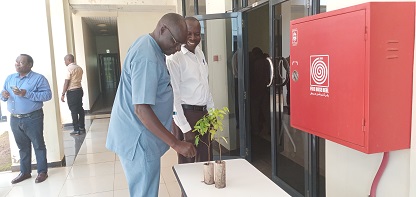
Nursery trials
The director Mount Elgon tree Growers
Enterprise George Sikoyo explained that his team has set up four trial sites
within the outskirts of Mbale city where they have tree seedling nurseries.
Instead of potting the tree seedlings
in plastic potting, they have used biodegradable plastics. At the moment they
treat the materials with insecticide to avoid penetration of insects.
Some of the trials are on raised
tables all in the effort to avoid insect penetration. The sites are acting as
demonstration sites where farmers growing vegetables and tree seedlings come to
learn on site and they have appreciated the technology.
Dr Nuwanya and team intend to formalize intellectual property issues with Uganda Bureau of Standards in order
to roll out the technology.
However the team is calling upon the
private sector to come on board to take up the technology for commercialization because the product is environmentally friendly.